


Developer or client shortlisting contractors
The buyer wants to know what scale of work you deliver, which sectors you understand, where you operate, who leads the projects and whether your recent work resembles their brief.
 Get a Free Quote
CONSTRUCTION WEBSITES / PERTH, WESTERN AUSTRALIA
WordPress websites for Perth builders, commercial contractors, fitout companies, civil contractors and construction specialists that need to get shortlisted for serious work. We structure the site around capability, project evidence, sectors, delivery model, team, licences/certifications supplied by the company and the enquiry or tender pathway — not around stock hard-hat photos and a generic 'quality workmanship' statement.

BUYERS SHORTLIST BUILDERS BEFORE THEY CALL
A homeowner researching a renovation, a developer checking a commercial contractor and a procurement manager prequalifying a subcontractor do not need the same page. The site should make the company's scope, project scale and evidence immediately clear.

The buyer wants to know what scale of work you deliver, which sectors you understand, where you operate, who leads the projects and whether your recent work resembles their brief.
Commercial and government-adjacent buyers often look for licences, insurances, HSEQ information, certifications, policies and capability documents before inviting a contractor further into the process.
Residential and design-and-construct buyers compare project style, budget/scale fit, process, communication and actual completed work long before requesting a quote.
A construction company's website also receives trade, supplier and recruitment traffic. Those pathways should be separated so commercial enquiries are not buried in one general inbox.
STRUCTURE THE SITE THE WAY A BUYER PREQUALIFIES YOU
The examples below are page families, not assumptions that every contractor offers every service. We build around the sectors and delivery models the company actually wants to pursue.

Show project scale, sectors, delivery model, locations and representative projects so a commercial buyer can quickly decide whether the contractor belongs on the shortlist.

Fitout buyers care about occupied-site constraints, programme, finishes, coordination and previous environments such as office, retail, hospitality or healthcare where relevant.

High-consideration residential work benefits from project stories, process, design collaboration, inclusions boundaries and realistic next steps rather than a gallery with no project context.

For contractors in civil, utilities or infrastructure, pages can separate work types, plant/capability, geographic coverage and project evidence so tender teams are not forced to interpret a generic construction page.

Industrial buyers often evaluate programme, staging, safety, live-site constraints and comparable facilities. The site should surface those proof points where they are real.

If recurring maintenance or remedial work is a real service line, separate it from major projects so facilities and asset managers can see response model, work types and contact pathway.
SITE VISITS AND PROCUREMENT REVIEWS HAPPEN ON PHONES TOO
A director reviewing contractors between meetings or a site manager sharing a project reference should be able to find the relevant capability and project without fighting a desktop-only portfolio.

Filters by sector, service, location or project type help buyers reach the most relevant work without scrolling through one long gallery.
Where approved, show scope, sector, location, delivery model and the challenge or outcome the company can substantiate.
Commercial buyers can be directed to the appropriate estimating, business-development or tender contact instead of a reception inbox.
If the business uses capability PDFs or policy documents, we create a clear document area and publishing workflow so outdated files are less likely to remain live.
CAPABILITY + SECTOR + LOCATION
Construction search intent is often a mix of service, sector and geography. We map the strongest useful page to that intent and use location content where the company genuinely works, has projects or has an operational presence.
Commercial buyers need sectors, project scale, delivery model, team and comparable projects rather than a generic homepage.
Fitout intent should lead to relevant environments, programme capability and completed work.
Osborne Park is a major commercial/industrial business area; local context should come from real office, project or service activity.
Industrial buyers care about facility type, live-site conditions and relevant project evidence.
The page should match the type of work the company actually pursues in the northern corridor.
Use local project evidence where available rather than creating a keyword-only location page.

PROOF FOR THE SHORTLIST
Construction buyers need more than testimonials. We organise real project evidence, company capability and current credentials so the website supports due diligence before a meeting or tender invitation.
Use approved project photography with client/sector, scope, location, delivery method and project details the company is entitled to publish.
Builder registrations, trade licences or other statutory credentials are displayed only from current information supplied by the company.
ISO certifications, safety systems, policies and prequalification information are structured for procurement where current evidence is supplied.
Only display logos where the company has permission or an established commercial basis to do so; do not imply endorsements that have not been given.
Profiles can show roles, project experience and delivery responsibility so buyers know who sits behind the capability statement.
GOOGLE BUSINESS PROFILE + CONSTRUCTION WEBSITE
A construction company may serve the entire Perth metro area, but local proof is strongest when it comes from offices, projects, sectors and real operating coverage rather than dozens of duplicated location pages.
Osborne Park and Welshpool are major commercial and industrial business zones; Perth CBD and West Perth support corporate and fitout demand; Joondalup and Wanneroo continue to grow in the north; Cannington and Midland connect key commercial catchments; Rockingham serves southern industrial and residential markets. We use those locations only where the company's work supports the relevance.
Keep office, yard or showroom details consistent across the website and owned local listings.
Where approved, local project case studies are stronger evidence than generic statements that the company works everywhere.
Commercial fitout in the CBD, industrial work in Welshpool or residential projects in Joondalup may require different proof and landing-page emphasis.
Use genuine client feedback without editing it into a broader claim than the client actually made.
A location page should add local projects, service context, office information or a materially different buying pathway.
Use Search Console to identify which capability/location combinations generate visibility before expanding the site.
FROM CAPABILITY SEARCH TO A PROJECT OR TENDER CONVERSATION
The website should help the construction company distinguish a serious project opportunity from a supplier email, subcontractor registration or employment enquiry before everything reaches the same inbox.
The buyer enters through commercial construction, fitout, industrial, residential or another genuine capability page.
Relevant capability entry pointProjects, sectors, scale and delivery information demonstrate fit before the buyer asks for a meeting.
Shortlist confidenceCurrent licences, certifications, policies and leadership information support procurement review.
Due-diligence proofThe form captures project type, location, timing and useful first-step information and can route to estimating or business development.
Qualified opportunityThe enquiry moves into the company's agreed email, CRM or tender process with source and capability context preserved.
Clear internal handoffWe can separate project opportunities, subcontractor/supplier registration, careers and general contact so estimators and business-development staff are not manually triaging unrelated messages.
CONSTRUCTION WEBSITE PRICING
Construction website scope increases with project volume, capability/sector pages, HSEQ/document requirements, tender forms, careers and the number of local/operational markets the company needs to support.
Current Perth construction web pricing puts a small builder/trade website around A$2,000–A$4,000, mid-tier contractor websites with portfolios, capability pages and certifications around A$4,000–A$8,000, and larger commercial platforms from A$8,000 upward. A current Australia/NZ 2026 builder guide also places professional builder websites around A$4,000–A$8,000. We use working comparison points of A$4,000 / A$7,000 / A$12,000; each Alpha guide price is exactly 60% of that reference — 40% lower.For a focused builder or contractor needing core capabilities, a credible project portfolio and a direct project-enquiry pathway.
Typical delivery: 3–5 weeksFor an established contractor needing sector pages, detailed projects, credentials, tender routing and stronger Perth search architecture.
Typical delivery: 5–7 weeksFor commercial builders, civil/industrial contractors or multi-division groups requiring extensive project, document, team and procurement structure.
Typical delivery: 7–10 weeksGuide prices are in AUD. The construction company must supply and approve project details, client names/logos, licences, registrations, certifications, insurance/HSEQ statements, safety claims and tender documents before publication. Photography/video, copywriting, advanced document systems, external CRM subscriptions and ongoing SEO/content are separate unless included in writing.
Additional approved design / development: A$90/hrSELECTED CONSTRUCTION-AND-CAPABILITY DESIGN PATTERNS
The examples below come from the existing Alpha portfolio. Where a construction-specific concept is shown, it demonstrates visual direction; other projects demonstrate multi-service conversion structure. We do not present unrelated work as a completed construction client engagement.
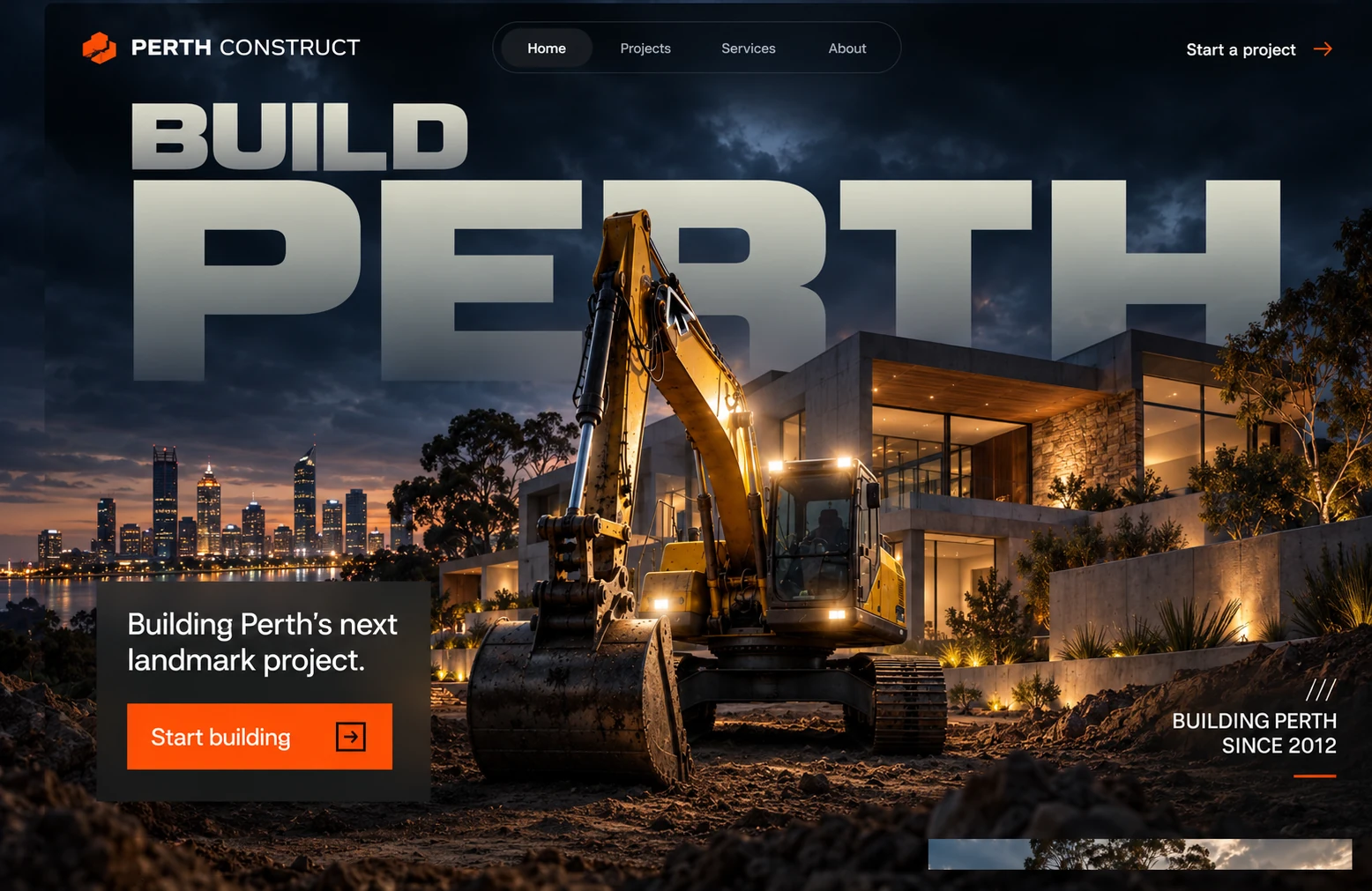
A construction-focused concept showing capability, project-led hierarchy and a more architectural visual language.
View project ↗
A live built-environment project demonstrating material/service presentation, project imagery and commercial credibility.
View project ↗
Demonstrates how multiple installation services, project types and enquiry intent can be structured within one service-led website.
View project ↗CONSTRUCTION WEBSITE QUESTIONS BEFORE YOU COMMISSION A BUILD
Straight answers about builder website cost, project portfolios, capability statements, HSEQ proof, tender forms, Perth SEO and ownership.
Current Perth construction guidance places small builder/trade websites around A$2,000–A$4,000, mid-tier contractor websites with portfolios and capability pages around A$4,000–A$8,000, and larger commercial platforms from A$8,000 upward. Our guide packages are A$2,400, A$4,200 and A$7,200, each exactly 40% below its working market reference.
Usually clear capability and sector pages, detailed project case studies, company/team information, current licences/certifications supplied by the business, tender/project contact and useful procurement documents. The exact architecture should follow how the company actually wins work.
For significant work, usually yes. A dedicated project page can show sector, scope, location, delivery model, approved imagery and key details. Smaller projects can remain in a filtered gallery where a full case study would add little value.
Yes. We can create a controlled document area for current capability statements, policies or certifications. The company is responsible for supplying approved and current versions.
Yes. We can separate project/tender, subcontractor, supplier, careers and general-contact forms and route them to different recipients or supported CRM workflows.
Yes when the company supplies current, accurate evidence and approves the wording. We do not invent registrations or imply a certification covers services or entities it does not actually cover.
Yes where the business has real capability, projects or operational relevance. We prefer pages with local project and sector evidence for places such as Osborne Park, Welshpool, Midland or Rockingham rather than copied suburb pages.
Typical guide timelines are 3–5 weeks for Builder Essentials, 5–7 weeks for Contractor Growth and 7–10 weeks for Commercial Capability Platform once project photography, credentials, copy and approvals are available.
Yes. We inventory project, service and location URLs, preserve valuable paths where practical and map 301 redirects for changes before launch.
Yes, subject to clearly identified third-party licences or hosted services. We provide the agreed WordPress/admin handover and do not intentionally lock the business into an agency-only proprietary platform.
START WITH THE PROJECTS YOU WANT TO BE SHORTLISTED FOR
Tell us your sectors, project scale, strongest work and how a serious opportunity reaches your team.
Share your current website, capability statement, project list, Perth operating areas, licences/certifications, tender process and the sectors you want to grow. We will scope the website around procurement and project-fit decisions rather than a generic builder template.